Wednesday, 27 March 2019

Queen of Culinary Cities


The small-holders market at Porta Palazzo, 
everything on sale is produced by the stall-holders
Porta Palazzo Market, the gastronomic heart and rumbling tum of Turin, lies to the north of the city centre. It fills, the not inconsequential space, of Piazza della Repubblica, selling clothes, shoes, household-goods, haberdashery, plants and every kind of food imaginable. Every Saturday, just around the corner in Borgo Dora, there is also the Balon, an antiques market. On Sundays, twice a month, when there is no other market, there is an even bigger bash, known as the Grand Balon. The reputation of these markets is such, that they say in Turin, “if you are looking for something, just go to Porta Palazzo.”

I had never stayed in the market area and I wnted to see the city from that side. I booked the art Albergo Restaurant San Giors.
www.albergoristorantesangiors.com-torino.com/en/ It looked like it had character; the restaurant sounded promising; and the position was perfect. 
The Art Hotel and Restaurant San Giors 
on Borgo Dora

We arrived right in the thick of it, on a sunny, Sunday morning in March. The streets were crammed with stalls, and people were swarming like flies. The only hope of moving along, was to go with the flow. Traffic and parking are strictly banned on flee market days as there isn’t an inch of available space. Small restaurants and bars crowd along the curve of Via Borgo Dora. There is chatter and laughter around the tables, everyone wants a spot in the sun and if you are in the know, you can ear mark a table for when it comes free. We ate indoors. Potatoes with squid and peas and diminutive pasta purses filled with an aubergine stuffing. The food was simple, inexpensive, satisfying fare and came with plenty of people watching opportunities. 

The daily market is said to be the largest outdoor market in Europe. It is cut into four distinct quarters, by two dissecting roads that bring buses and trams, delivering shoppers from all sides of the city. A service road runs around the entire square but it’s easy to lose your bearings as each quarter looks the same.


Young cavolo nero leaves and radish
My destination is the Mercato del Orologio, the covered Clock market, where a gastronomic Eden of brightly lit, delicatessens, grocers and butchers beckon even the most reluctant Adam. There are also stalls, stacked floor to sky with kitchen kit and then there is the piece de resistance, the small-holders shelter, La Tettoia dei contadini, a grey, unimpressive but pretty, cast iron construction. On entering, the scents and atmosphere of the countryside fills your senses. It is like coming across a secret garden. This is where growers from a radius of 30 miles around Turin, bring the fruit, vegetables and herbs of their labour. The produce is picked at first light, driven in, dropped at the gate, and set up here, ready for opening time at seven, every morning, whatever the weather. Everything you see and buy here is grown locally. The root vegetables in the crates look as if they have just been pulled out of the ground with their long sheaths of green still attached. Blue plastic packing cases are lined up edge to edge, creating a visual kaleidoscope of springy salad leaves, greens and herbs.


Wild poppy shoots
Mounds of seasonal produce inspire what is going to be cooked today for lunch. No paper, no plastic, no packaging. Men and women shoppers, vie for space around their favourite stalls with their voluminous bags and shopping trolleys, chatting with the stall holder-growers. These are the same people who plant and harvest and transport this green manna from heaven. I look on and listen jealously, longing to follow any one of the house-holders home to their kitchens to discover what it is that they will be cooking today. I day-dream about joining them for lunch.


Celariac
There are three more quarters in the square to discover, over the road is the covered fish market and the tightly regimented rows of red and yellow canopied stalls of the orto frutta market, selling fruit and vegetables from up and down the peninsular and around the globe. It was June the last time I was here, and the stalls then spilled over with summer fruits, strawberries, cherries and peaches and the air was heavy with their sweet perfume. Asparagus was in season, as were all the early summer vegetables, peas, broad beans and courgettes. Today, the tang of citrus fruit fills the air, there are piles of Sicilian blood oranges everywhere. It is spremuta, time. The first aubergines and artichokes are on sale from the South. Competition is not seen as a problem here, market-trader calls, attract attention but price and quality are key to savvy shoppers.  The walk-ways between stalls are long, narrow and dead straight, and the overhanging canopies afford shy glimpses of the bright winter sky and momentary shafts of sunlight.


Just one of many kitchen stalls at Porta Palazzo market


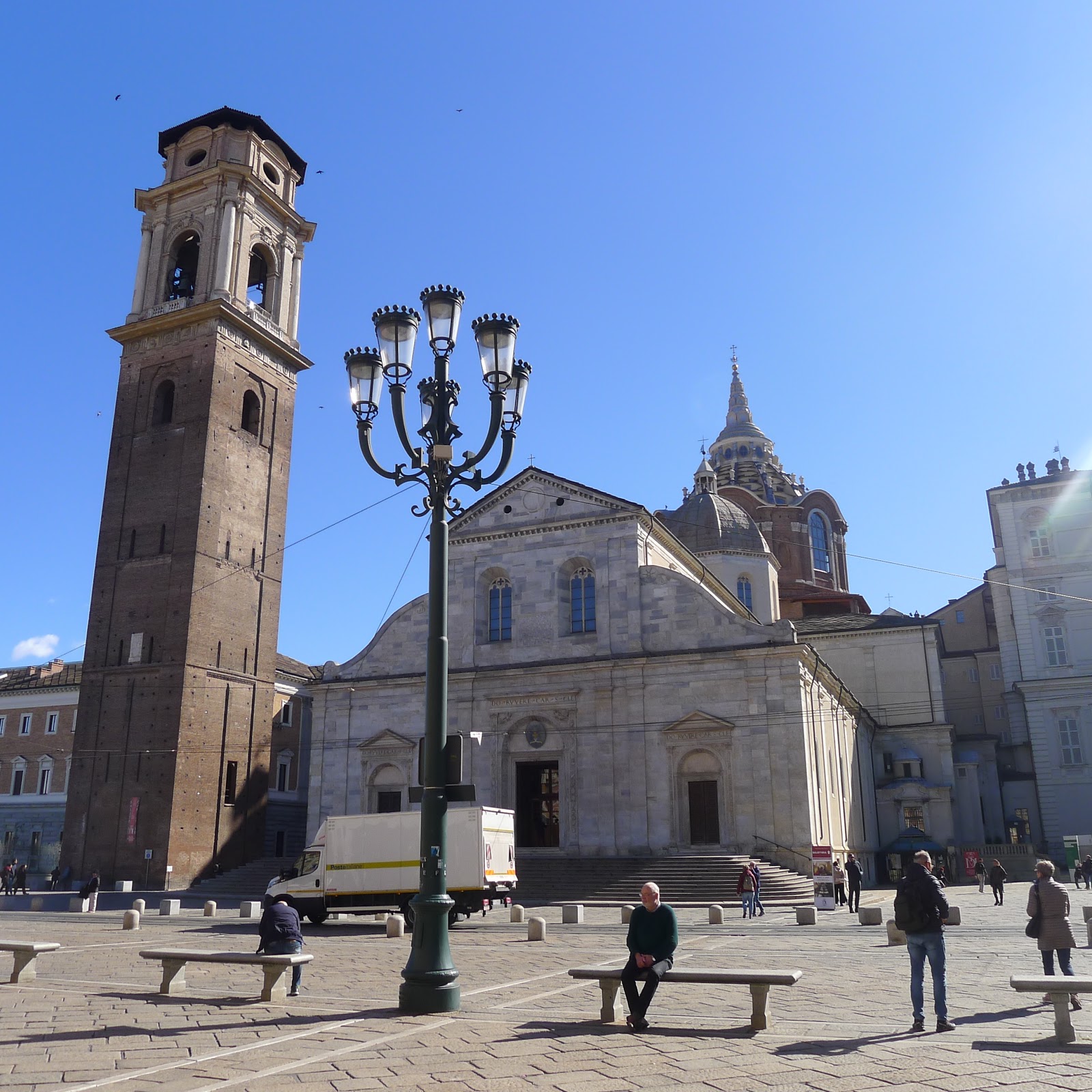
The cathedral square of San Giovanni

The remaining quarters of Piazza della Repubblica are home to the sprawling stalls of the Abbigliamento, the clothing market and the Calzatura, the shoe market. There is a strong ethnic presence around Porta Palazzo, there are Moroccan influenced bars, signs in Arabic script, eateries and shops, selling Eastern clothing, food and bric-a-brac. 
It’s a fun area to stay and handy for much of the city centre, but like all tourist-crowded areas, you need to keep your wits about you. The lovely Cathedral of San Giovanni, containing the Turin Shroud is a stone’s throw away. You can walk to the Quadrilatero from here to enjoy the contempory night-life scene.                     

fun for the kids outside 
the Egyptian museum
An afternoon visit to Superga
After the rain! Time 
for an aperitivo 
in Piazza Vittorio


A short walk away you can enjoy the elegant Piazza Castello and the Royal Palace and castle, Via Roma and Piazza San Carlo, Piazza Vittorio and the Via Roma with its elegant shops, but remember the lunch time pausa when most shops are closed. These places are all connected by the city’s convenient colonnades, affording shelter from the heat in summer and from the wind and rain in winter.   

Beyond the city scape, the parks and green hills that surround Turin is the dome of the Superga Basilica. Should you fancy a wild white-knuckle ride on a super bumpy bus as it speeds over the city’s tram lines, followed by a sedate lift to the top of the leafy hill in a quaint funicular railway, it’s a lovely afternoon’s outing. You can have ice cream or refreshments at the top, but unless you are a devotee of the Savoia royals, I would suggest avoiding the visit to the family tombs, once entered the cloister, the key is turned in the gate and there is no escape until the bitter end. www.basilicadisuperga.com/en/

The Molle Antonelliano, houses the 
National Museum of cinema
You can’t fail to spot the Molle Antonneliano, Turin’s Tour d’Eiffel rising over every streetscape as you take in the city. You can ride to the top in a vertiginous glass lift. It’s not until you come up close that you observe the remarkable architectural detail of the building. If you are a film buff, it houses the comprehensive and fascinating, Museum of Cinema. www.museocinema.it/en Turin is also home to a world-famous Egyptian museum, second only to Cairo. https://www.museoegizio.it/en Take your time, the collection is extensive and fascinating. The motor museum is a delight www.museoauto.it/website/en and there are loads of art museums to visit.

Turin is probably the most foody city you will ever visit. Capital of chocolate; it is where chocolate was first turned to a solid; in other words, chocolate as we know it. Hot chocolate drinks such as Bicerin https://bicerin.it are a must.
Caffe' Mulassano is the perfect place 
to rest a while for an aperitive

Gianduia, that heavenly mix of hazelnut and chocolate, myriad sweetmeats and an endless seam of colourful and luscious patisserie must all be sampled https://delcambio.it/it/farmacia-del-cambio/home.  The tramezzino or dainty sandwich is said to have been invented in one of the Torino’s historic cafes in Piazza Castello http://www.caffemulassano.com/. Grissini were first made here for an ailing prince. Vermouth was concocted and then popularised by a young herbalist, called Carpano. The aperitive was born here. www.brancadistillerie.com/en/product/antica-formula 

Try and hit this charming café at tea time 
to enjoy a Bicerin, a special hot 
chocolate and a few home made biscuit
Torino’s restaurants are legendary, www.turinitalyguide.com/where-to-eat-like-a-local-in-turin its seasonal specialties include the mountain-fair of fondues and cheeses; on a clear day, the snow-capped Alps drift into view like clouds around the city. The rice is grown on the flatlands in the shadow of the mountains, on the plains of the rivers Po and Dora, providing endless streams of creamy al dente risottos. The hills of Langhe and Roero to the south are awash with a long list of noteworthy wines. In autumn and winter the unmistakable aromas of white and black truffles and wild mushrooms fill the air. Piemonte's cattle provide the tender lean veal, the fassona, for the many raw meat signature dishes and the beef for the celebrated Bollito.


Organic bread from Aosta at the 
Campagna Amica Market
in Piazza Cavour Gardens
If all this wasn’t reason enough to crown Torino a queen among foody cities. Torino is also the home to the biannual Slow Food show. The Terra Madre Salone del Gusto is a five-day food romp https://salonedelgusto.com that showcases an astonishing array of artisan food and its producers from Italy and around the world; much of it would be endangered, were it not for Slow food.


The Torino I remember in my twenties was always a beautiful well dressed and well-mannered city, at the height of its industrial past. Remember Michael Caine in The Italian Job. Its royal palaces and gardens, its elegant Parisian style, tree line avenues, the colonnaded squares and streets, the churches and elegant cafes formed the perfect back drop for the city’s industrial royalty, captains of industry and their customers and its hard-working people.

People still flock to Torino from far and wide, for Terra Madre and Salone del Gusto and the many international events held at Lingotto. The Winter Olympics did much to bring the city to the attention of the world. Parks and piazzas are filled regularly with people pulling events. There is always something special going on. I only hope that some of the hundreds and thousands of business people and skiers who pass through Torino Caselle airport on their way to Lingotto or the Alps might return to see more of this cultured, culinary capital and even venture beyond into the heart of Piedmont.

Tuesday, 15 August 2017

Bonito at its best


Aji Tataki, pounded skipjack on the island of Shikoku

Whilst visiting Japan, researching sashimi for my latest book Raw and Rare, I was taken to Taisho, a small town, covered market in Kochi in Southern Shikoku by my friends Chikaku and Koichi.  The goal was to meet Mr Tanaka and to learn about Tataki, Kochi’s pounded and seared skipjack tuna speciality, the crème de la crème of the sashimi feast. Mr Tanaka travels the world to show off his skills but today he is busy in his fish shop at home.


Taisho has all the trappings of the famous food markets in Kyoto and Tokyo but is of a manageable size to fulfil the needs of a small local population. A pitched timber roof hung with brightly coloured banners and hundreds of red and blue carp kites celebrating “Boys’ Day”, provides shelter from the driving rain and the two facing rows of small shop units selling food stuffs. cloths and household items. We run the gauntlet of the stalls, coming to a halt next to the fish.


Mr Tanaka steps forward; he presents the classic image of the Japanese fishmonger from an ancient wood-block print. He wears a long, dark grey, apron wrapped tightly around his slight form and a matching, close fitting gilet. His  bald head is uncovered save for the shaved grey stubble at ear height. Introductions are made, we smile and bow to one another.


The Bonito Katsuo

He picks up two bulging but taught silver torpedo shaped bonito by their slender tails, (they are about fifty to seventy centimetres long, with a girth of possibly equal proportion) and slings them onto a cutting bench. He sets to work, slicing off the heads at a sharp angle and filleting the dark red, translucent flesh inside. He slices along the spine cutting the bonito in half and then cuts these again, creating four long triangular shaped fillets. He lies one of the fillets on one tray and the other three are thrown casually into another. He repeats the process with the other bonito and explains that three fillets are harder and lumpy and are therefore destined for the searing treatment. The remaining fillet is perfectly uniform and soft in texture; this will be used for sashimi. He explains that both touch and smell indicate the quality of each piece of fish. Sashimi quality fish is of the highest grade.


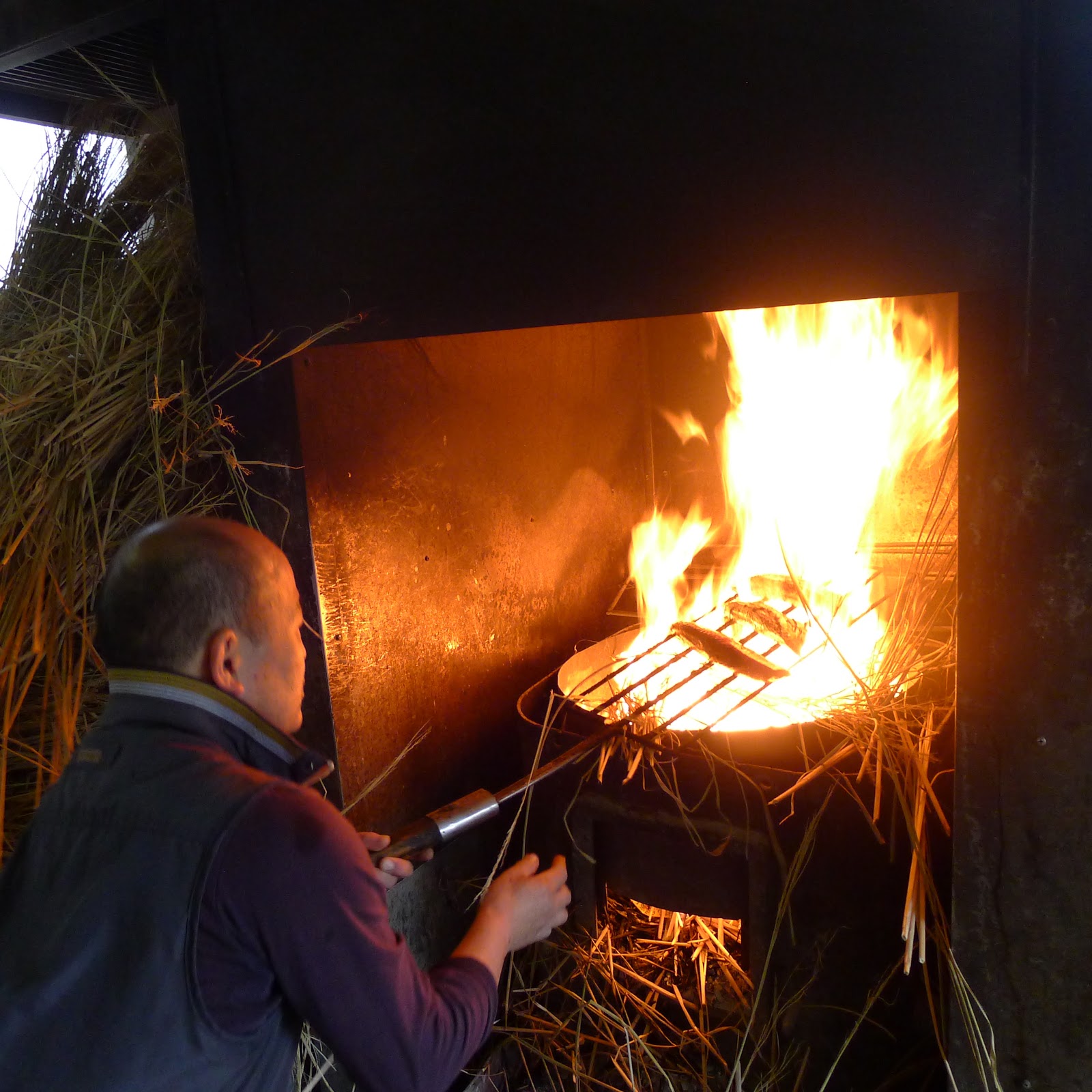
We follow Mr Tanaka, behind the shop to where there is a pile of rice straw and a kind of brazier. The straw is piled high and ignited, sending wild flames into the air. The fillets of bonito are salted generously and then pounded and laid across a giant fork-like griddle with a long wooden handle, which is introduced to the flames. The griddle is moved moved around in the fire for about 4 minutes, then pulled out of the fire and rested on a table top. The bonito is turned once on the “fork” and returned to the flames just for a minute or so.


 Back in the fish shop we watch him slice the seared bonito and then follow him to his busy little eatery (the equivalent of a market caff) opposite his shop. Mrs Tanaka sits us down and makes us welcome. Here, squeezed in around a small table, we feast on the sublime tuna accompanied by spring onion, shredded daikon and ponzu dipping sauce. We are surrounded by locals, all enjoying our lunch. 


Wednesday, 22 May 2013

They look a bit tired and sad and require a lot of cleaning but with the correct preparation and cooking they are full of flavour and can be used to good effect.


The Heart of the Matter

Fresh globe artichokes in varying shades of purple and green, and in various shapes and sizes, are a show stopper in any street market from spring though to summer in the Mediterranean. Not so very long ago, fresh globe artichokes (not to be confused with Jerusalem artichokes) were a rarity outside of specialist greengrocers but they are now creeping into mainstream supermarkets up and down the country.
These are not the young tender hearts we are familiar with preserved in oil.


They look a bit tired and sad and require a lot of cleaning but with the correct preparation and cooking they are full of flavour and can be used to good effect.
The artichokes can be cooked in advance and added to the freshly cooked pork when ready to serve.

NB a quick version of the recipe can be made using preserved artichokes. Simply drain a small jar of artichoke hearts and slice them thinly and arrange on kitchen paper to get rid of the excess oil. Prepare the pork tenderloin as below, top with the sliced artichokes, sprinkle with a tablespoon of finely chopped parsley mixed with 1 small finely chopped garlic clove, cover with a lid and leave for 5 minutes, shaking the pan from time to time.

Pork Tenderloin with Sliced Artichoke in Garlic, Parsley and White Wine
Serves 4

500 g pork tenderloin
Juice of ½ lemon
2 large fresh artichokes
2 garlic cloves, finely chopped
A good handful of flat leaf parsley, finely chopped
225 ml white wine
125 ml cold water
2 tablespoons of plain flour, seasoned with plenty of salt and pepper
A handful of flat leaf parsley
Extra virgin olive oil
Extra finely chopped flat leaf parsley for serving

Cut away any sinew or fat on the tenderloin and cut into 2 cm thick slices. Arrange well spaced out, cut side down on a board and flatten them with the palm of your hand. Then cover with a length of cling film and using a rolling pin beat the pork pieces evenly to 5 mm thick slices and reserve.

Squeeze the lemon juice into a bowl of cold water. Clean the artichokes; trim the stem leaving 3-4 cm and scrape with a potato peeler. Pull away the tough outer leaves and scrape the base with the potato peeler. Cut the artichoke in half down through the stem, cut away the top of the leaves leaving the base and 1-2 cm of the leaves. Scoop out the choke using a serrated grapefruit spoon if you have one. You  will be left with the tender base and stem. See photographs. Immerse in the acidulated water until required.
When required, drain the artichoke halves, dry thoroughly on a clean tea towel and slice thinly.
Cover the base of a large frying pan with extra virgin olive oil, add the finely chopped garlic and parsley and put on low heat. When the garlic and parsley start to wilt, add the prepared artichokes and increase the heat. Cook for 3 minutes, turning the artichokes in the oil from time to time. Add salt, 125 ml of the wine and 125 ml cold water and cook for a further 20-25 minutes or until tender. Cover with a lid after the initial 5 minutes. Add extra water if necessary.
When ready to serve, dip the prepared pork tenderloin slices in the seasoned flour. Put a second frying pan on high heat and when hot add enough extra virgin olive oil to cover the base. Add the meat slices and brown on both sides then add the remaining 100 ml white wine. Reduce the heat and turn the meat in the pan juices.
When the artichokes are ready, transfer them to the pan containing the meat, making a single layer on top of the meat. Add the pan juices and cook for 3 minutes, lid on. Switch off the heat; add the finely chopped parsley and rest for a few minutes before serving with waxy new potatoes tossed in a little extra virgin olive oil or butter.

Asparagus time again!


Well it is asparagus time again and yet again, I cannot resist coming up with a new asparagus recipe for you. Enter, on cue, the first stubby, Wye Valley asparagus; probably rather later than usual as everything is way behind this year.
As you know from past years I get very excited about the new season’s crop of asparagus because I totally ignore all imports that arrive on our shores throughout the rest of the year. I feel much the same about, strawberries, raspberries, runner beans.....shall I go on?
There is no more delicious a starter than lightly cooked asparagus spears served in melted butter or with extra virgin olive oil. You might like to add a little grated Parmesan cheese or some black pepper, even some lemon juice but it is hardly necessary if the asparagus is freshly picked and freshly cooked. Dip them in a lightly boiled egg yolk or put them on toast with a poached egg. Add them to pasta dishes and risottos as the main event. This time around I have combed them with prosciutto and pancetta and put them in and on a tart.

Asparagus and Prosciutto Tart - serves 6-8

Pastry
150g plain flour
15 g corn flour
1 teaspoon sieved icing sugar
pinch of salt
90 g softened butter
2 small free-range egg yolks
1 tablespoon dry white wine or iced water

Filling
8 tender thick asparagus spears
4 slices of prosciutto cut in half
4 eggs
250 ml double cream
50 g parmesan cheese
Handful of parsley, finely chopped
Freshly milled pepper
140 g cubed pancetta

Utensils
Loose based tart tin 26cm, buttered
Rolling pin
A circle of baking parchment 2-4 cm larger than the tart tin
Dried beans for baking blind

Preheat oven to 220 F 425 C gas 7 then lower to 180C 350 C gas 4

Put the flours, icing sugar and salt in a bowl; add the softened butter, egg yolk and white wine if using. Quickly and lightly knead the ingredients together into a smooth ball. Wrap in cling film and set in the fridge for an hour to rest.
While the pastry is resting prepare the asparagus; snap off the tough ends of the spears. Cut the spears in half. Wrap each tip half in a half slice of prosciutto; arrange in a roasting tin and reserve.
Put 250 ml of salted water on to boil. Cut the bottom half of the spears into 1 cm lengths and cook for 2 – 3 minutes or until tender. Blanch in ice cold water, drain and pat dry.
When the pastry has rested, roll it into a neat circle on a well floured work surface. The pastry should be 3-4 centimetres larger than the tin.
Line the tart tin with the pastry, put the baking parchment on top and fill with the baking beans.
Put in the pre-heated oven for 10 minutes, or until golden around the edges, at the higher temperature. After this time, take out and discard the parchment and the beans. Paint the base with a little egg white.
Cook the asparagus and prosciutto rolls in the same oven for 5 minutes and reserve.
Put the eggs, cream, parmesan cheese, chopped parsley and pepper in a small bowl and whisk well, add the asparagus bits and the pancetta, mix once and pour into the tart tin and cook at the lower temperature until set, say 20 minutes.
Take the tart out of the oven, arrange the asparagus rolls around the top and leave to cool, take the tart out of the tin and serve with new potatoes and salad as a main course or on its own as a starter.